
A New Exhibition Takes Flight
Art professor and environmental advocate, Deirdre Murphy’s work to be in the first contemporary art exhibition at the Audubon Center at Mill Grove
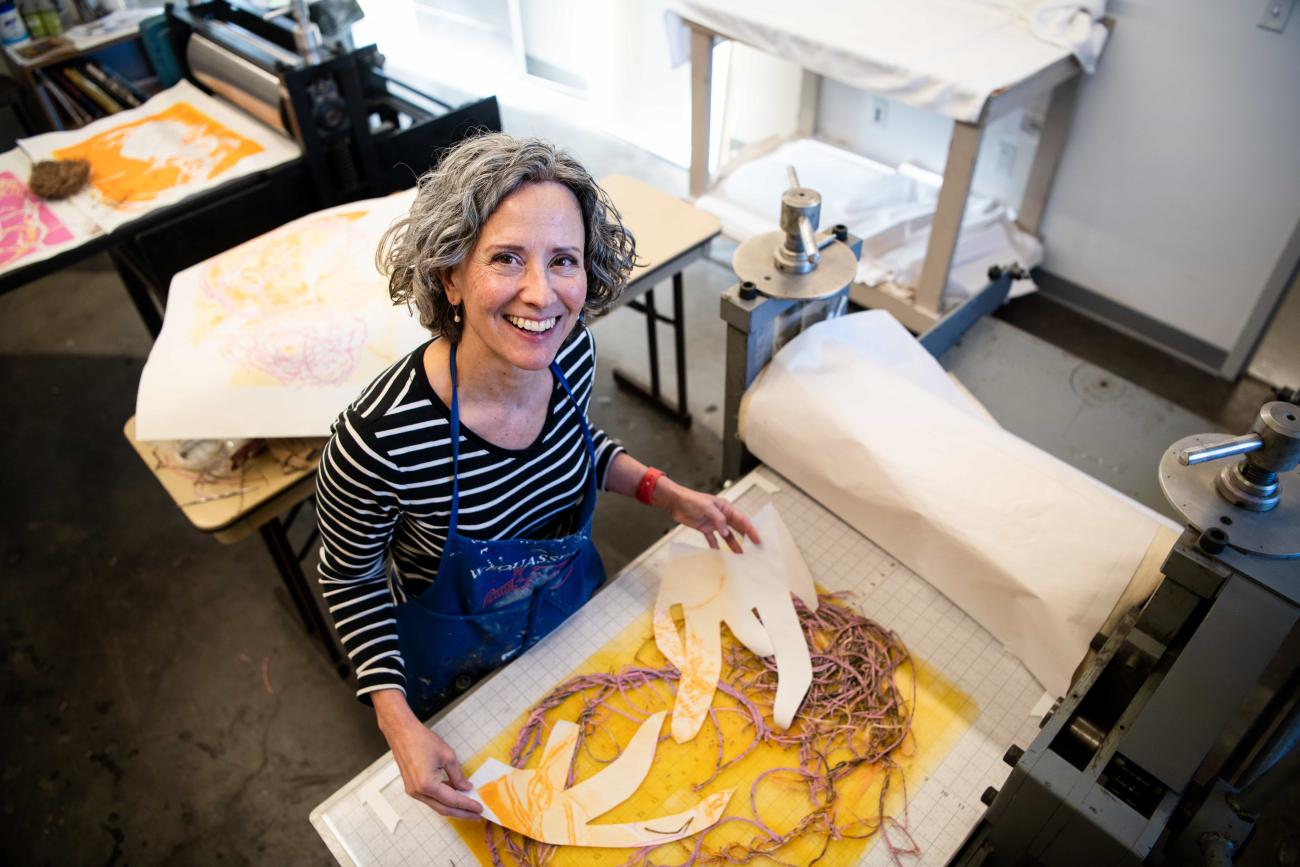
In the lively classroom space of Building C, artist Deirdre Murphy is in her element. Surrounded by her flock of students and their works-in-progress, Murphy’s prints, mixed media, and paintings inspire a fun and hopeful approach to conservation. Beautiful, bright colors draw in the viewer, while her enthusiasm for art, climate activism, and teaching do the rest.
Found feathers fall to the floor as Murphy pulls out her latest collaborative mixed-media project. Her work often features birds and explores themes of environmental awareness and justice. Much of her art has been inspired by the work of John James Audubon among other early naturalists. Lehigh’s special collections even has a double elephant folio book of over 400 prints from his The Birds of North America, Murphy notes excitedly. “[Birds] have this ability to see from multiple vantage points. And as an artist, we try to see the world differently. And so I always envied birds—still do—that ability.”
Murphy, assistant teaching professor of art in the Department of Art, Architecture, and Design, will be the first contemporary artist featured in a new series at the John James Audubon Center (JJAC) Museum at Mill Grove. Curator Heather Moqtaderi, museum and collections senior coordinator for the National Audubon Society, reached out to Murphy to launch the program, which aims to shine a light on artists who are continuing Audubon’s legacy of art and education.
Audubon is regarded as one of the greatest 19th-century American artists and naturalists, known for painting realistic birds in their natural habitat. His book, The Birds of America, published between 1827–1838, depicts 435 life-sized watercolor paintings of North American birds, reproduced from copper plates.
Other parts of Audubon’s legacy are harder to reckon with including his owning of slaves and racist writings. By showcasing the work of contemporary artists, the JJAC hopes to highlight environmental justice and focus on conserving ecosystems, protecting natural habitats and reconnecting people with nature.
The JJAC is a nonprofit nature center and bird sanctuary outside Philadelphia where Audubon lived when he first emigrated to America from France. Today, his estate is home to a museum which includes a new interpretive center, miles of nature trails and the original three-story farmhouse along the Perkiomen Creek, known as the Historic House.
From April to August, Murphy’s exhibition at the Audubon Center will focus on “Home Making,” that explores how birds, insects, plants and humans create—often co-create—homes and habitats. It will include her paintings and prints while collaborative works with sculptor Yvonne Love will be on exhibit in the Historic House. The immersive installation invites visitors to imaginatively inhabit Murphy’s “paper garden.”
Birds of a Feather
Inspired by nest cavities discovered during her residency at the Lower Merion Conservancy, her paintings offer a “bird’s eye view of climate change.” These oil and acrylic works are “looking through the woodpecker hole,” she explains. They are at once familiar and a portal to a new way of seeing things.
Murphy asks herself and the viewer, “If I was a bird, what would I see?” From predators to changing seasons, and from local plants to urban scenes, her “Gradients of Growth” series delves into the impact of climate on tree cavity-nesting birds.
Science truly meets art with Murphy’s contemporary herbarium prints. Her print series was influenced by Lehigh’s Trembley Herbarium collection. She worked with Lehigh scientist Robert Booth, professor of Earth and environmental sciences, to highlight native pollinators. “These native plants host insects that increase the biodiversity that the songbirds will eat. It’s about the whole ecosystem that sustains them,” she explains.
She takes flora sprigs like bee balm, larkspur, calycanthus and amsonia, lays them on a layer of ink, and uses a press to print a relief onto cotton paper. She uses little rectangular strips of paper on the stems and branches to echo the botanical tape on traditional prints that kept the specimens in place. This series, she says, really focuses on the importance of planting native gardens to help the environment and mitigate climate change.
Murphy’s collaborative work with sculptor Yvonne Love uses field notes from Love’s father, who recorded a bird census count every day for over three decades. By sending the art back and forth, they will create these mixed-media experimental drawings for the Historic Home. “Collaborating with other people, I find that really inspires me,” she says.
Lehigh student Holly Fasching ‘26 will be the student artist at the Audubon Center at Mill Grove at the same time as Murphy. An award-winning wildlife photographer, Fasching will be showing photography and printmaking in the museum’s student gallery. Her photo of an osprey mid-flight over a misty forest in Wyoming placed in the 2024 Audubon Photography Awards Top 100.
“It'll be nice bringing my research practice and then education practice together,” Murphy says. It’s a full-circle moment for both her and Fasching.
Migrating to New Destinations
Murphy’s exhibition at the Audubon Center aligns with another piece of exciting news—she was asked to be an artist for The Aviary, an illustrated series in Audubon magazine. The artwork is featured on the back page of every issue of the magazine, which has a circulation of over 400,000. “This has been a bucket list item for myself for so many years,” she shares.
“I want to highlight a local bird, a migrating songbird, that’s a tipping point bird,” she says. “So it’s an indicator species of how we’re doing with climate change. I was thinking of the golden-winged warbler because they’re hurting, and they need some light shined on them so that we do our part.”
Murphy was sure to pick a species for the magazine project that wasn’t in severe decline or near extinction because that climate anxiety is something we’re used to. “That feeling of helplessness is something that I see in our students when I talk about only the doom and gloom,” she says. That’s why art is the perfect vehicle for her to talk about conservation and ignite realistic interest for others to learn how to do more.
A Caw to Action
Another of Murphy’s public works is the Birdsong mural at Schauffele Plaza in Ardmore, Pennsylvania, which has vibrant, colorful soundwaves of migratory songbirds painted on the ground of the plaza.
“Science and conservation is embedded with all of my public work that I do. We will have a QR code to eBirds or to a conservation center. So I'm always trying to do that, make it alluring that you want to look at it, but then have that quick little link like, ‘Oh, what could I do to save the birds?’”
A big focus for Murphy is tapping into empathy “that looking at a data set doesn’t do.” Feelings of helplessness don’t lead to action. “The more that I studied about murmuration and flocking patterns and things like that, then I really got interested in the science end of things.”
“I want to leave this planet better than I found it. It's my responsibility for sure. I think it's all of our responsibilities, but I want to do that with this kind of beauty.”
From Fledgling to Educator
Murphy has always thought of a bird as a narrator in her life. “Maybe it’s my Irish heritage background of storytelling,” she says thoughtfully. She recounts stages of her life like the lifecycle of a bird. When her children were young, it was like “you're all stuck in the nest just because of that intensive, wonderful domesticity.” As her family grew, they became a flock and eventually left the nest.
In addition to teaching painting, drawing, printmaking and two-dimensional design foundations, Murphy also teaches an art and climate change class. “I've always loved the natural sciences, but always knew my calling was to be an artist and a teacher,” she remarks.
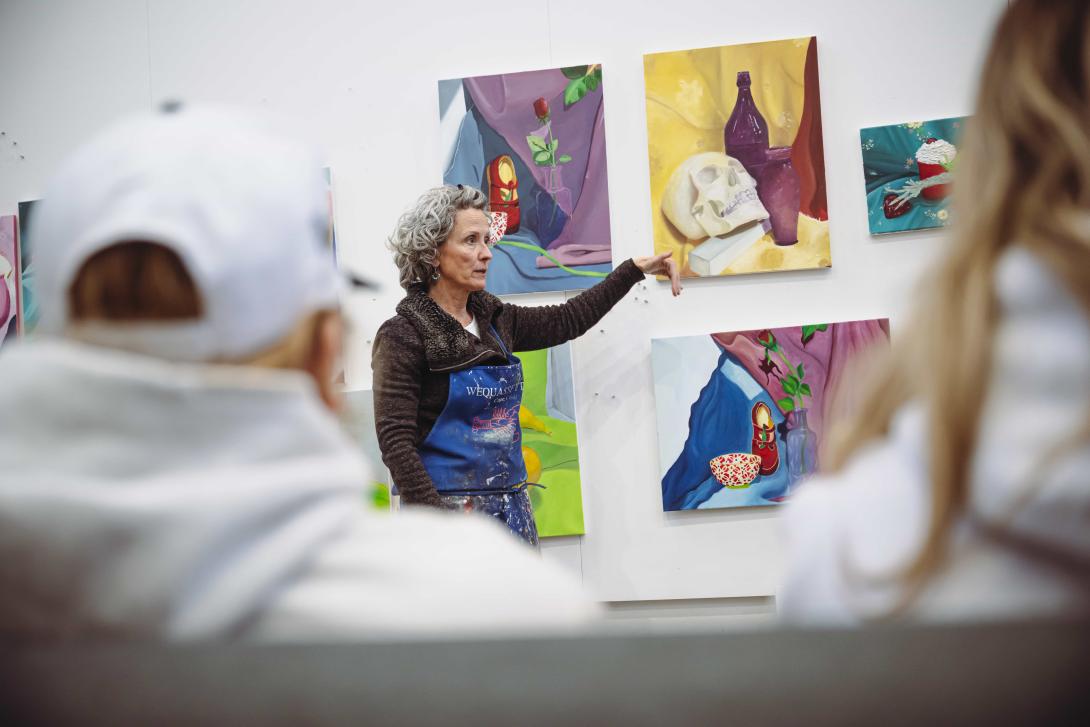
“It’s so great teaching here because we have incredible experts. Lehigh’s faculty and staff are just so generous with sharing their knowledge.”
“I think I just never really tire of the topic, and I'm always learning so much.” Through ornithology she realized “there's a story to tell. There's a way to hopefully help change and reshape our future.”